
As daylight gets shorter, adjust your outing time
Sunrise, sunset and solar elevation vary by place and date. In winter, when days are shorter, you can walk after sunrise. When it is hot or the Sun is high, check the UV Index and weather alerts before going out. Keep vitamin D food sources in mind; when you see the 30° prompt, pay closer attention to them.
Why are winter days shorter?
Earth’s axis is tilted about 23.4° from the perpendicular to its orbital plane. After the June solstice, the Northern Hemisphere gradually tilts less toward the Sun. The Sun’s daily path above the horizon shortens, and daylight decreases until the December solstice, then grows longer again. The seasons are reversed in the Southern Hemisphere. In general, the difference between summer and winter day length grows farther from the equator. Local latitude, longitude and the horizon also affect sunrise and sunset times.
How long are winter days in Beijing and Guangzhou?
Take Beijing (39.9042°N) and Guangzhou (23.1291°N) as examples. In China Standard Time, the winter solstice falls on 2026-12-22. Using a solar declination of about −23.44° for a simplified estimate, the Sun’s maximum elevation is about 26.7° in Beijing and 43.4° in Guangzhou. With day length estimated from the Sun’s centre at the horizon, Beijing has about 9.2 hours of daylight and Guangzhou about 10.6 hours.
Maximum solar elevation is estimated as 90° minus the absolute difference between local latitude and solar declination. Day length assumes the Sun’s centre is exactly on the horizon. This simplified method omits atmospheric refraction, the time difference caused by the Sun’s apparent disk and terrain, and does not use precise astronomical data. The figures compare the two cities; they are not observed sunrise or sunset times and cannot be used to estimate skin vitamin D production.
Under this prompt rule, Beijing is below 30° and gets a prompt to pay more attention to vitamin D food sources; Guangzhou is above 30° and does not get one for this reason. The 30° mark only prompts attention to dietary sources. It is not a physiological cutoff for skin vitamin D production and cannot determine whether an individual is deficient. In either city, check the day’s UV and weather before going out, and keep food sources in mind year-round.
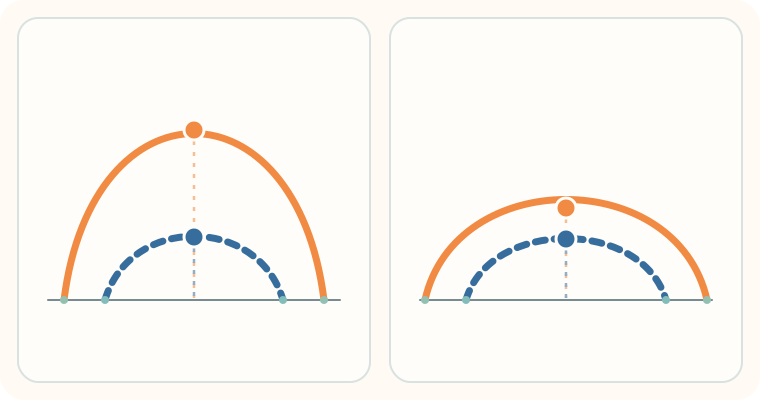
Left: the solar paths at one location near the June and December solstices. Right: the paths for Beijing and Guangzhou near the December solstice. Orange marks June or Guangzhou; blue marks December or Beijing.
Solar paths are conceptual geometric illustrations, not to scale; see the article text for estimates.
How long are Beijing’s days around the summer solstice?
Around the summer solstice on 2026-6-21, solar declination is about 23.44°. Using the same method, Beijing’s maximum solar elevation is about 73.5° and daylight lasts about 14.8 hours. Compared with the winter solstice, the Sun is higher and the day is longer. Check the day’s UV and temperature when planning an outing; daylight hours are not all suitable for sun exposure.
When should you go out?
If it is already dark when you finish work, move your walk to lunchtime or another daylight period. In hot weather, choose a route with shade and places to rest. In a new city, plan around local weather and UV rather than reusing your previous schedule.
When buying fish, look for varieties that contain vitamin D. For breakfast drinks, check the nutrition label for vitamin D. The 30° prompt is a cue to pay more attention to food sources; it is not a reason to eat large amounts of any one food.
Check UV before going out, and keep vitamin D food sources in mind.
Check the UV Index when planning protection, and consider the weather and temperature when deciding when to go out. For foods that contain vitamin D, see the food sources article on this site. 晒研社’s App is still in development.